
Choosing Agv Amr solutions in 2026 requires more than comparing vehicle prices. The right system must fit your warehouse, production flow, people, and future plans. A narrow aisle, uneven floor, or frequently changing workstation can affect performance. Small details matter. A practical evaluation begins with site measurements, traffic mapping, payload checks, and real order data. It should also examine battery routines, charging locations, navigation accuracy, and integration with WMS or ERP platforms. Experience shows that a robot performing well in a demonstration may struggle during peak shifts. That difference deserves careful attention.
Reliable selection depends on evidence, not impressive promises. Ask vendors for documented throughput, recovery procedures, maintenance records, and integration results from comparable facilities. Review safety functions, operator training, cybersecurity controls, and support coverage before signing a contract. A pilot project can reveal blocked routes, slow handovers, and unexpected human behavior. These findings are valuable. They are also easy to ignore. Some forecasts will be wrong, especially when product mixes or staffing patterns change. Therefore, the evaluation should include flexible software, clear performance targets, and a realistic total-cost model. Consider installation, infrastructure, spare parts, training, downtime, and future expansion. The cheapest option may become expensive after one year. A more capable solution may still fail if employees cannot use it confidently. The best decision balances measurable productivity with practical usability, verified safety, and long-term service reliability. The following guide examines these factors and shows how to compare Agv Amr systems with greater clarity in 2026.
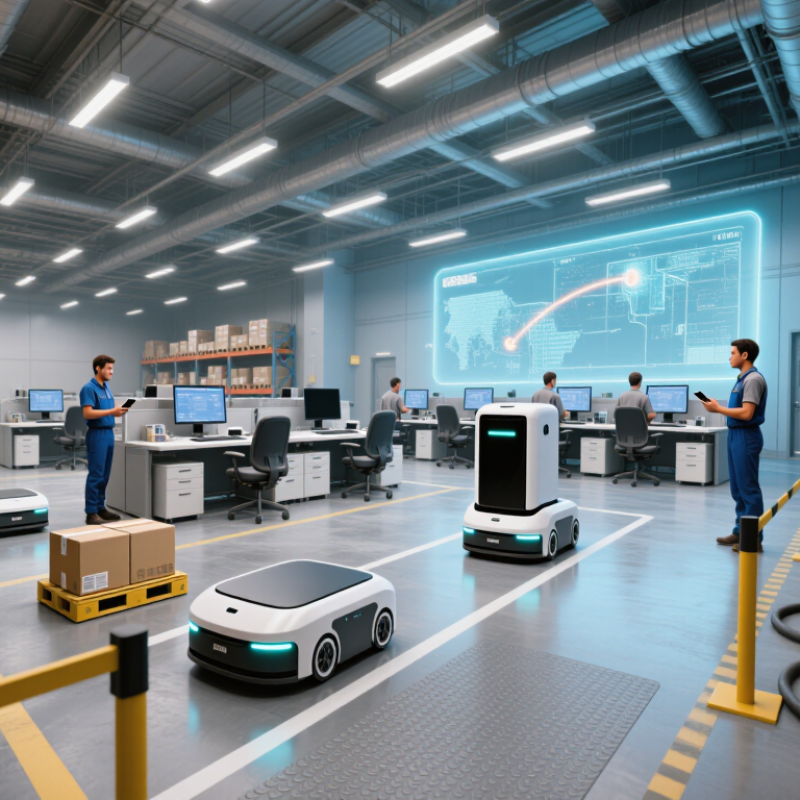
How to Choose AGV AMR Solutions in 2026?
An automated guided vehicle, or AGV, follows controlled routes inside a facility. It may use magnetic tape, floor markers, wires, or fixed digital paths. AGVs are effective for repetitive transport between stable locations. Their movement is predictable and usually easier to standardize.
An autonomous mobile robot, or AMR, navigates with sensors, maps, cameras, and onboard software. It can detect obstacles and select another route when conditions change. That distinction matters. However, the boundary is not always clean.
AGVs often suit high-volume workflows with clearly defined lanes and limited variation. AMRs offer greater flexibility for mixed traffic, changing storage areas, and evolving production layouts. An AMR may pause beside a worker, recalculate its path, and continue safely. An AGV may require route changes or additional infrastructure.
This can affect installation time, maintenance skills, safety planning, and long-term operating costs. Real facilities are messy. Dust, narrow aisles, uneven traffic, and inaccurate maps can reduce expected performance. A solution that looks efficient on paper may need careful testing.
Tips
Observe the workflow during a busy shift, not only during a quiet demonstration. Measure travel distance, waiting time, payload weight, aisle width, and obstacle frequency. Ask how the system behaves after a blocked route or sensor fault. Check integration with warehouse software and emergency procedures. Start with a controlled pilot. Review the results honestly, because the first design may need revision.

Choosing AGV and AMR solutions in 2026 starts with the material, not the machine. Map every movement from receiving to storage, picking, staging, and shipping. Record load weight, dimensions, handling frequency, and delivery urgency. A trolley carrying sealed cartons needs different support than a rack-moving vehicle. Watch the real workflow for several shifts. Peak-hour congestion often stays hidden during a short inspection.
Measure facility constraints carefully. Note aisle width, floor joints, slopes, door thresholds, ceiling clearance, and pedestrian crossings. Mark charging areas and emergency access routes. Wireless coverage also matters in metal-heavy warehouses. AMRs can suit changing routes, while AGVs may fit stable, repeatable lanes. However, the choice should follow workflow evidence, not fashionable terminology. Keep people in the assessment. Ask operators where delays, awkward lifts, and unsafe pauses occur.
Integration deserves equal attention. Check warehouse software interfaces, traffic rules, barcode quality, and manual fallback procedures. A technically capable vehicle can still fail when labels are damaged or tasks arrive in bursts. Small tests reveal this. Run a pilot during the busiest shift, using representative loads and actual floor conditions. Our early assumptions are not always right. A route that looks efficient may create queues near a fire door or packing bench. Leave space for maintenance, battery charging, and future layout changes. Measure completed trips, waiting time, blocked paths, and operator acceptance. Numbers help, but they do not explain every hesitation. Listen closely.
Compare navigation, safety, payload, and fleet management features against real operating conditions. A vehicle that navigates well across a clear test floor may struggle when pallets shift or people cross its route. Check how the system handles blocked aisles, changing layouts, and localization loss. Ask for a live trial in your facility. Watch the vehicle near doorways, racks, and busy intersections.
Payload is more than the rated load. Include the weight and dimensions of carts, totes, and fixtures, then consider turning space, floor quality, and stopping distance.
Review safety sensors, warning signals, and controlled-speed behavior with workers present. No system removes every operational risk; clear routes and staff training still matter.
Fleet software should show traffic, battery status, task queues, and fault alerts. Check whether dispatch rules fit your shift patterns and existing workflows.
Tips: Test a typical peak-hour route, not only an empty aisle. Ask operators to try routine recovery steps, such as clearing a blocked path or responding to a low-battery alert. Record delays and manual interventions. One overlooked corner can change the result. Revisit your assumptions after the trial; the first layout estimate is often imperfect.
How to Choose AGV AMR Solutions in 2026?
In 2026, selection should begin with workflow evidence, not impressive demonstrations. Map pallets, aisle widths, floor conditions, handoff points, and peak-hour congestion. Integration depends on clear interfaces with warehouse software, elevators, doors, scanners, and safety systems. Request a live test using your own route data. Test the bottlenecks. A polished demo can hide delays.
Scalability means more than adding robots. Check whether traffic management supports mixed fleets, new zones, changing priorities, and seasonal volume. Ask how quickly operators can create missions without coding. Measure throughput at 60%, 80%, and 100% capacity. The middle result may look attractive. It may not survive Monday morning. Review data from several operating shifts, not one carefully prepared trial.
Maintenance deserves equal attention. Review battery replacement time, spare-part availability, remote diagnostics, and technician training. Record mean repair time during the pilot, even if the sample is small. That number is imperfect, but ignoring it is worse. Costs hide elsewhere. Total cost should include software licenses, infrastructure changes, integration labor, training, energy, downtime, and eventual replacement. Compare five-year cost per completed move, not purchase price alone. Leave room for mistakes; layouts change, assumptions fail, and promised utilization may never arrive.
How to Choose AGV AMR Solutions in 2026?
Select the Best AGV or AMR Solution for Long-Term Operations
Long-term automation starts with the daily workflow, not the vehicle specification. Map pallet weights, aisle widths, floor conditions, traffic peaks, and charging locations. A machine that performs well during a quiet demonstration may struggle at 4 p.m. when orders surge. Check how it handles wet floors, narrow turns, mixed pedestrian traffic, and temporary obstacles. These details often decide uptime.
Tips: Run a realistic pilot for several weeks. Measure completed missions, charging time, manual interventions, and recovery after errors. Ask operators where delays actually occur. Their feedback may challenge the original layout. Also review maintenance access, spare-part availability, software updates, training, and integration with warehouse systems. Low purchase cost can become expensive when support is slow.
Choose the solution that can adapt as operations change. AGVs may suit stable routes and repeatable movements. AMRs can offer greater flexibility in dynamic environments, but they still need disciplined traffic rules. Compare total operating cost over five to ten years, including batteries, service, integration, and downtime. Require clear safety documentation and performance records from real applications. Do not accept vague promises. Some assumptions will be wrong. Build review points into the contract, and leave space for process improvements after deployment.
| Evaluation Dimension | AGV | AMR | Best-Fit Scenario | 2026 Selection Guidance |
|---|---|---|---|---|
| Navigation method | Fixed routes using magnetic tape, wires, reflectors, QR markers, or mapped paths | Map-based navigation using LiDAR, cameras, inertial sensors, and onboard software | AGV: stable, repetitive routes AMR: changing routes and mixed traffic | Choose the navigation architecture that matches the expected frequency of layout and process changes. |
| Typical payload range | Approximately 100 kg to more than 10,000 kg, depending on vehicle design | Commonly approximately 100 kg to 1,500 kg; heavier platforms are available for selected applications | AGV: heavy, dedicated material movement AMR: carts, totes, racks, and pallets | Specify payload as vehicle load plus container, fixture, and safety margin; do not size from product weight alone. |
| Route flexibility | Low to medium; route changes may require infrastructure or engineering work | High; vehicles can normally select alternative mapped paths around obstacles | AMR: facilities with frequent SKU, aisle, or workflow changes | Use AMR when operational flexibility has measurable value; use AGV when route stability supports maximum repeatability. |
| Floor and infrastructure requirements | May require guide paths, markers, reflectors, dedicated lanes, or floor modifications | Usually requires a surveyed map, reliable localization features, suitable lighting, and defined safety zones | AMR: existing facilities where civil work should be minimized | Audit floor flatness, slopes, thresholds, rack geometry, reflective surfaces, and pedestrian access before purchase. |
| Traffic and obstacle handling | Performs best in controlled lanes with predictable traffic and limited obstruction | Designed to detect obstacles, slow down, stop, and re-plan within defined operating limits | AMR: pedestrian-heavy or dynamically changing environments | Validate recovery behavior, not only detection. Confirm how the fleet handles blocked aisles, stalled vehicles, and lost localization. |
| Typical operating speed | Common industrial designs operate around 0.5–2.0 m/s, subject to load and safety limits | Common industrial designs operate around 0.8–2.0 m/s, with speed reduced in shared areas | Both can support routine intralogistics transport when cycle time is correctly modeled | Compare completed missions per hour, including loading, unloading, waiting, charging, and traffic delays. |
| Deployment timeline | Often longer when guide paths, controls, or dedicated lanes must be installed | Often faster for pilot deployment when maps and interfaces can be prepared without major construction | AMR: phased automation and rapid proof-of-concept programs | Require a documented pilot-to-production plan with acceptance tests, training, and change-control milestones. |
| Fleet management | Central control commonly coordinates routes, traffic priorities, charging, and station calls | Fleet manager commonly assigns missions, manages maps, controls traffic, and optimizes vehicle utilization | Both require centralized monitoring for multi-vehicle operations | Prioritize open APIs, clear event logs, role-based access, dashboard export, and support for mixed vehicle fleets. |
| System integration | PLC, conveyor, warehouse control, manufacturing execution, and warehouse management interfaces | Warehouse management, warehouse control, manufacturing execution, robot, elevator, door, and conveyor interfaces | Both suit structured digital workflows | Request interface documentation, simulator access, data ownership terms, and integration responsibility before contracting. |
| Charging approach | Opportunity charging or scheduled charging; battery chemistry and capacity vary by duty cycle | Opportunity charging, automatic docking, or battery exchange depending on fleet design | Both can support multi-shift operations with correct energy modeling | Model peak demand, charging dwell time, battery degradation, and spare-vehicle requirements over the full shift. |
| Safety framework | Risk assessment, protective scanners, emergency stops, warning devices, and controlled travel zones | Risk assessment, protective scanners, 3D or vision sensing, emergency stops, and dynamic speed control | Both require site-specific validation and worker training | Assess compliance with applicable machinery, mobile-robot, electrical, and workplace-safety requirements in the target region. |
| Maintenance requirements | Mechanical components, drive systems, guide infrastructure, batteries, sensors, and control equipment | Drive systems, batteries, sensors, computing hardware, maps, software, and network connectivity | AGV: infrastructure maintenance must be included AMR: software and sensor maintenance must be included | Compare preventive-maintenance intervals, local service capability, spare-parts lead time, and remote-support coverage. |
| Scalability | Scales effectively on standardized, high-volume routes; capacity may require additional infrastructure | Scales flexibly by adding vehicles and adjusting software-defined workflows, subject to traffic capacity | AMR: variable demand; AGV: predictable high-volume transport | Test the fleet at projected peak volume, not average volume, and define the maximum supported vehicle count. |
| Best long-term KPI set | Mission completion rate, route availability, utilization, cycle time, charging availability, and maintenance cost | Mission completion rate, obstacle-recovery time, utilization, traffic delay, localization incidents, and maintenance cost | Both require operational, financial, safety, and service metrics | Set baseline values before deployment and review performance monthly against agreed service-level targets. |
| Total cost of ownership | Vehicle cost plus guide infrastructure, controls, installation, facility changes, energy, labor, and maintenance | Vehicle cost plus software, mapping, integration, network, energy, labor, and maintenance | The lower purchase price does not necessarily produce the lower lifecycle cost | Calculate five- to ten-year TCO using throughput, labor effects, downtime, expansion, support, batteries, and end-of-life assumptions. |
| Recommended decision rule | Select when routes are stable, traffic is structured, payloads are heavy, and throughput is predictable | Select when workflows, routes, demand, or facility conditions are expected to change | Hybrid deployment may be appropriate for sites with both fixed and flexible flows | Base the final choice on validated process data, safety results, integration readiness, and lifecycle economics. |
As a specialist in environmental and flow sensor technology, ScioSense enables companies to use the planet’s resources more sustainably, helping to create a healthier future for all.